Showing posts with label Arborvitae. Show all posts

Tuesday, April 11, 2017

I'm back!

Hello, Grey to Green fans, and happy spring!  I've been mostly ignoring my blog for the last eight months or so, but now with the arrival of warm weather, things are beginning to happen in the garden again.

The Japanese Maple has timed its budding just right this year - it missed the March frosts completely. 


Apparently if I wanted it to be a tall, straight, vertical tree, I should have pruned the bottom branches last year so that it could concentrate on growing its upper branches - but I just didn't have the heart.  So I think this tree will always be a semi-horizontal bushy thing.  No matter.  It's a beautiful tree no matter what.

You may recall that this was supposed to be an Orange Dream Japanese Maple, with a hint of orange when the leaves came in and bright orange in the fall.  That was a lie.  This is a plain ol' green Japanese Maple, and in the fall the leaves turn brown.  Again, no matter.  But I will not be buying trees from random guys on Amazon.com again.

The Upright Japanese Yew continues to be one of the stars of my garden.


It did very nicely over the winter (it is, after all, an evergreen) and it just thrives in the light-deprived conditions of my garden.  This was a purchase from ForestFarm of Williams, Oregon, and it was the best $35 I spent last year.  

Also from ForestFarm is one of my problem children, the "Mr. Bowling Ball" Arborvitae.  Arborvitae means "tree of life" in Latin, and someone should definitely mention that to Mr. Bowling Ball.


He's an evergreen too, but he looks like he's having a bad hair day.  I suspect he needs more sunlight than I can provide him.  If anyone is interesting in rescuing him from me, please let me know.

The winterberry hollies did well over the winter.  Since I stopped blogging in July, you never got to see that Red Sprite had four berries.  But here are a couple of photos from September showing them.  Aren't they lovely?


Jim Dandy and Red Sprite are just starting to bud for this year, and I'll be adding another female winterberry holly, called "Berry Heavy," to Jim Dandy's harem this year.  He can pollinate five female plants, maybe more.


Among the other plants that are doing well are the ligularia that Alice brought me, the helleborus that Jenn brought me, and the lamium that Liz brought me.  Thanks, all!


Meanwhile, in Hosta-land, there are little sprouts everywhere.


That last photo might be upside-down...  I think I can split that one with four sprouts.  I'm not positive which one it is because the pot got turned around, but I think it might be the Touch of Class hosta.

The heucheras are coming back to life too:


As for the rest, the hens and chicks plant looks pretty much dead, and there's no sign yet of the Bleeding Heart or the New Guinea impatiens or most of the astilbes, but I'm not giving up hope yet.  

There will be much to blog about in the coming weeks as new plants arrive.  Stay tuned!


Friday, May 27, 2016

Who's Surviving, Who's Thriving, and Who's Still Dead

As we head into the long weekend that marks the unofficial beginning of summer, I thought I'd walk you through the plants and how they're doing.

First, let's talk about the winterberry hollies, both of which appear to be thriving.   Jim Dandy, the male winterberry, is even blooming.


Ideally, he and Red Sprite should bloom at the same time, so that his blossoms can pollinate hers.   (Or, as my friend Mal recently described it, "plant sex.")  Unfortunately, Red Sprite seems to be a little behind schedule.  She's got buds, but they aren't blooming yet.


If she doesn't hurry up and bloom, there will be no berries this winter.  That would be sad.


About a month ago, all my hostas in the Jim Dandy pot were approximately the same size.  You can see how Victory has flourished.  It's going to need its own pot very soon.  I've bought the pot, but haven't gotten around to transplanting yet.

The Raspberry Sundae hosta has a couple of leaves that don't look so hot.


Too much watering?  That's my best guess, but if anyone can name that plant malady, let me know.


The New Guinea impatiens and the astilbes (one from my friend Liz, three bought online) are definitely thriving.  Mr. Bowling Ball (the arborvitae), not so much.


Not enough sun???  I'm going to give him a good pruning and see if that helps.

The paprika heuchera went through a rough patch, with most of its initial foliage browning up and dying, but there's been plenty of new growth, and a couple of the new leaves have that nice red coloring that makes "paprika" an appropriate name.


Upright Japanese Yew: surviving.  A little browning around a few needle tips.  The fern is thriving.


Serviceberry and hydrangeas: surviving.  There's been no sign that the hydrangeas are thinking about blooming.  Creeping Jenny: thriving.  Happily creeping in all directions.


Japanese maple and Blue Mouse Ears hostas: thriving.  The Japanese Maple is very leafy.  Two of the four hostas have buds that will turn into flowers.  Hostas are really known more as foliage plants than as flowering plants, but they do flower.


The darker green Japanese Maple leaves came before the frost this spring; the lighter ones came after.


Guess who's still dead.


But the European ginger and the hens-and-chicks seem to be thriving.


The plants from Jenn (hellebore and bleeding heart) are also thriving.  The bleeding heart seems to create new leaves on almost a daily basis!


And finally, a bit of good news: the Forever Purple heucheras have been shipped!  Hooray!

Thursday, April 14, 2016

Bring Me a Shrubbery

Two big boxes from ForestFarm arrived today.  I feel like the stars of the show have finally appeared, and I want to tell you about them all tonight.  So first, let's have a round of applause for...

The Upright Japanese Yew!


The Upright Japanese Yew is notable for its verticality, unlike other yews, which are likely to be hedgier.  This is not a moral judgment; it's all about shape.  Also, its needles are longer than those of a true yew.  The Latin name is Cephalotaxus harringtonii Fastigiata (genus, species, cultivar).  The plant was first known as the Japanese Plum Yew, but it's not actually a yew at all, never mind a plum.  It is, however, Japanese, so they got something right.

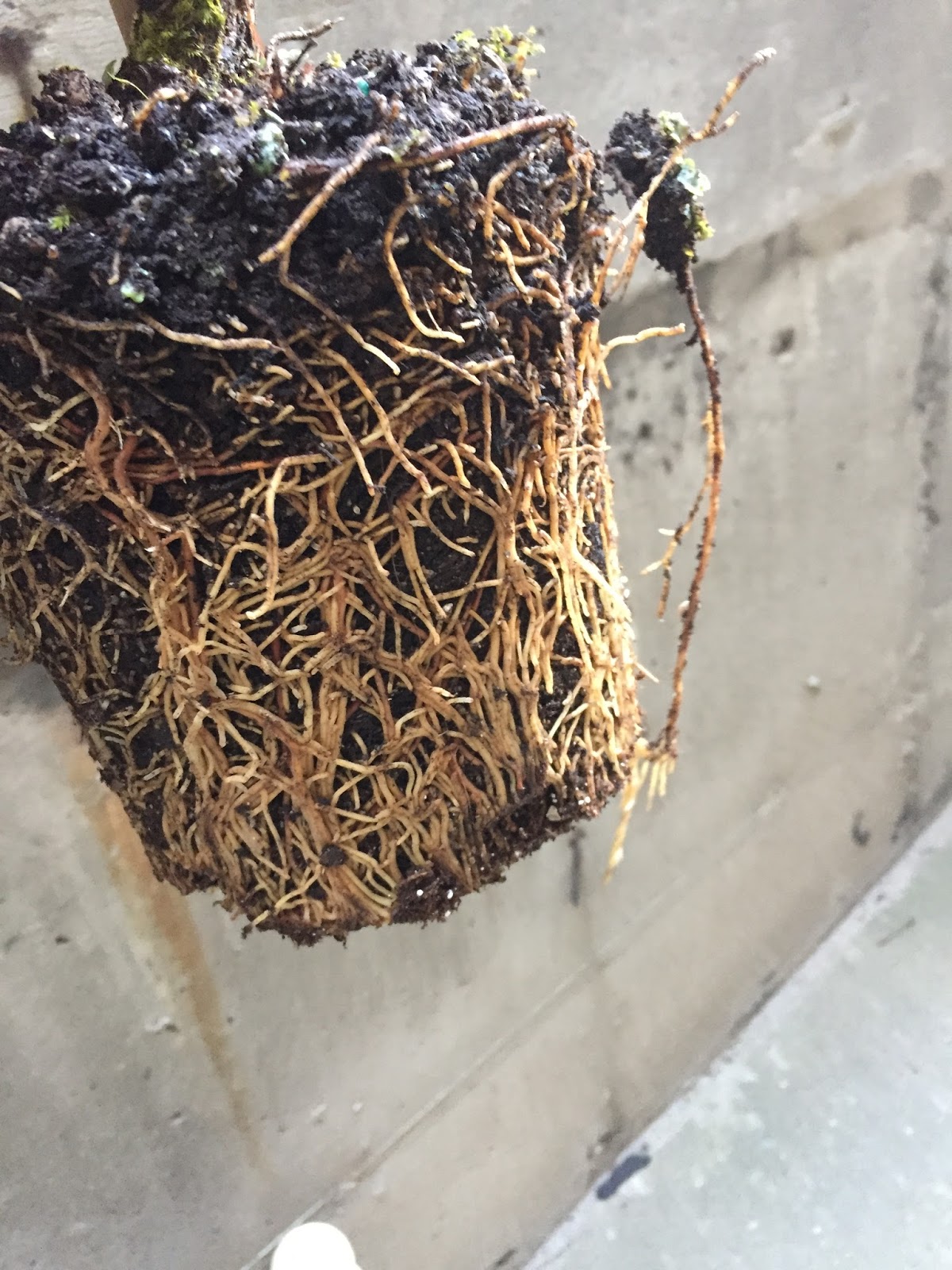
Sadly, when it arrived, the Upright Japanese Yew was quite root-bound.


I have only recently learned what "root-bound" means, but it's what happens when you grow a plant in a pot that's too small for it.  The roots have nowhere to go, so they wrap around the root ball.  It's

Thursday, March 17, 2016

The Plants of My Neighborhood, Or, Good Grief, Is That Another Boxwood?

Nothing much has happened in my garden since you last heard from me.  It rained a little, and my polka dot plants are looking nice, and the Japanese Maple is merrily budding away, but any photos would look just like Monday's photos.

So instead, today I'm going to talk about the plants of my neighborhood - specifically, the plants in pots and containers outside of restaurants and stores and apartment buildings.  If you think of New York City as nothing but gray, then you might be surprised by all of these plants.  However, if you live in the suburbs, it might make you sad that all of our urban plants appear to be living in captivity.

What I've noticed walking around my neighborhood the last few weeks is a lot of repetition.  For instance, there's arborvitae.


Arborvitae is an evergreen, recognizable for its flat, feathery needles.  (Forgive me if this is all too basic - I don't yet know who my audience is, and I am pretty much a gardening novice myself!)


The arborvitae in the photo below is no more.  It has ceased to be.  It's expired and gone to meet its maker.  But for some reason, it's still sitting in a pot in front of a restaurant.


There's also the holly.

And the ivy.


And the holly and the ivy.


And the yew.  (Only yew and yew alone.)


The yew needles are soft and flat, and the red berries (if any; none in this photo) are poisonous.


But there are two plants that are just everywhere in my neighborhood.  First, the boxwood.


Now, I get it.  The boxwood is evergreen; it is hardy in this region; and apparently any fool can grow it.  It looks fine whether it's groomed into a topiary or just allowed to grow in a natural shape.  Maybe next year, I'll put some boxwood into my garden.  But I just couldn't get excited about it this year.

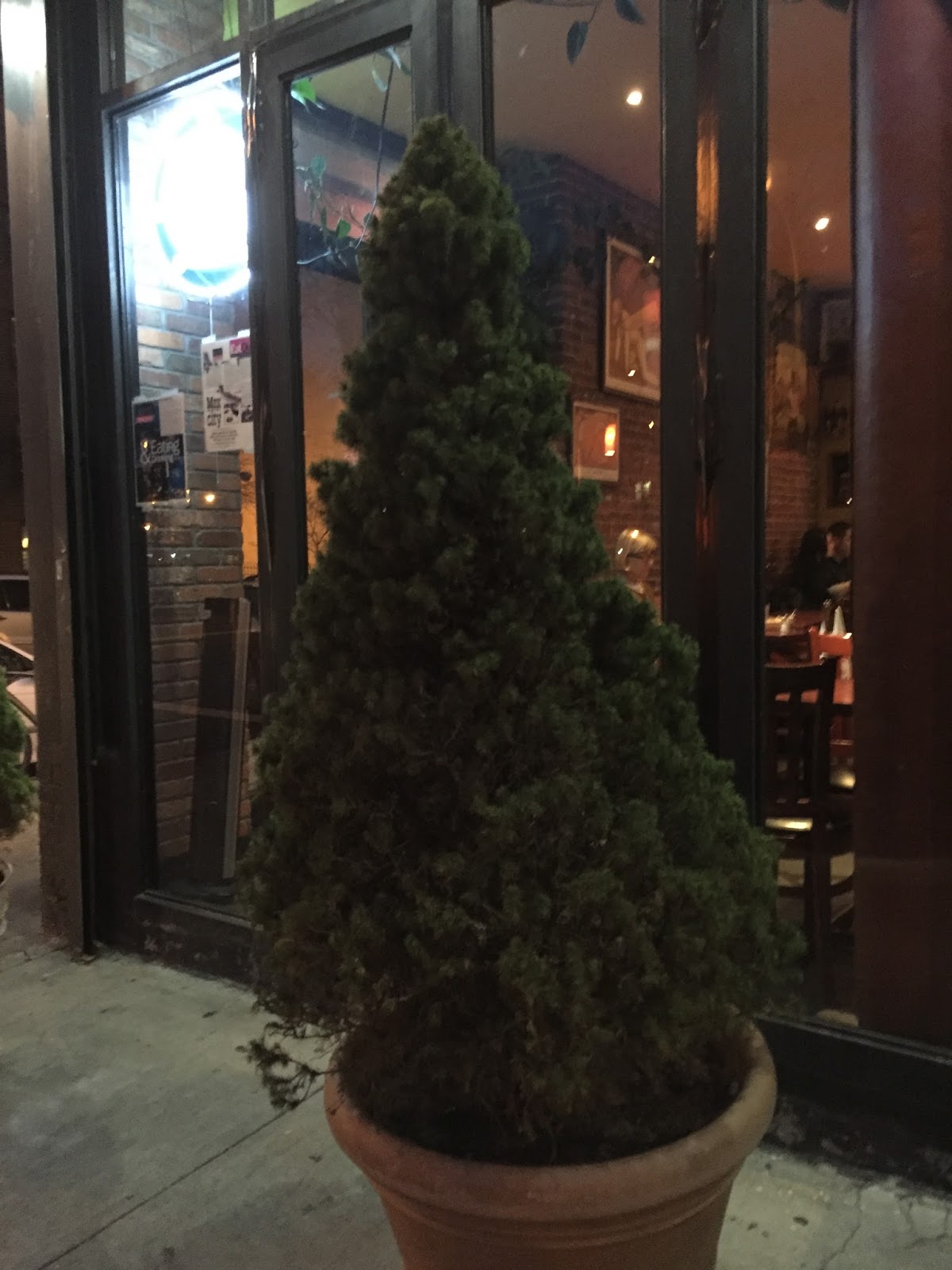
And then there's the Dwarf Alberta Spruce.  This one is also ubiquitous.


The needles are short and sharp.


It's like a little Christmas tree in a pot.  Again, I get why it's popular.  It's cute and friendly.  It doesn't need any pruning to give it that nice pyramid shape.  But I just can't get excited about it, and so there won't be any Dwarf Alberta Spruces in my garden this year.

So what will be in my garden this year?  I think I'm going to have to leave you in suspense for a while, or I'll run out of blog posts before the plants actually arrive in the mail.

A quick note: I will sometimes be mentioning brand names in my posts.   I have not received anything free from anyone; everything in my garden is purchased at retail.  If I mention store or brand names, it is only so others can find the same thing if they want to.