Showing posts with label Serviceberry. Show all posts

Tuesday, May 26, 2020

World's Longest Garden Walk Finally Concludes

We've reached the last group of pots in my garden, and I've managed to stretch it out over several weeks. 

Here's Pot 19.  The tallest plant is a Price William Serviceberry, a tree that would blossom and produce berries if it had enough sunlight, which it doesn't.  I've had it since 2016.  Below it, the Key West Hosta, and behind that, the Marmalade Lime heuchera and the Creeping Jenny.  All are thriving - though later in the season, the Serviceberry will develop some weird spots on its leaves.   I've never been able to figure out why.


Pot 14B is next.  Yes, I know it's out of order - I moved it last year, and I don't feel like renumbering it.  This is the Empress Wu hosta.  Empress Wu grows to be a very large hosta, so I may need a new pot sooner or later. 


Pot 20 is the dwarf Alberta Spruce, which I bought from Whole Foods in early 2018.  It will always be a tiny tree, but it's doing very nicely.


Pot 20A contains a new plant, the Beaujolais Heuchera.


Then we have Pot 14A, which is also out of numerical order.  In this pot are two Astilbes, which I bought bare-root from Breck's this year.  They are already beginning to bloom and are clearly going to be somewhere in the red family.  Also in the pot, though you can't see it amidst all the Astilbe foliage, is a small Italian Maple tree that came as a stowaway with a hosta I bought in 2018. It's right in the center of this photo and easy to miss.


The next pot is unnumbered.  It's the companion to the pot I showed you last week with the pansy in it, the pot that I wouldn't have bought if I'd known it's not insulated for winter.  So I plunked an annual from the Greenmarket in this one too - a little yellow snapdragon.


Then there's Pot 21, which is Exhibit A in the "My Garden Wants to Be an Oak Forest" story.  One Cathedral Windows hosta (purchased in 2018) is surrounded by three baby oak trees (self-planted, 2019). 


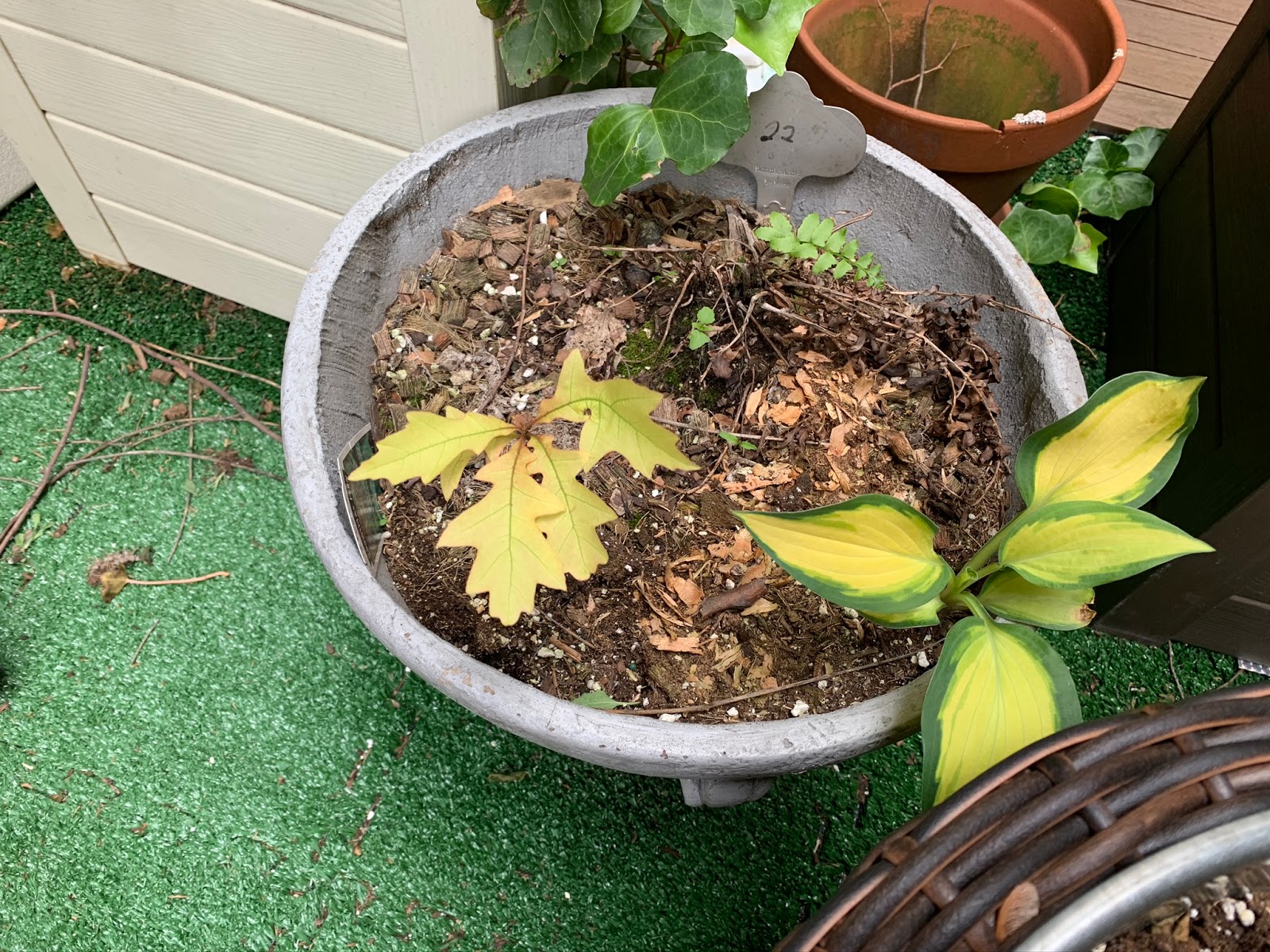
Pot 22: one nearly-dead Christmas Fern, one new bare-root hosta from Breck's, and one self-seeded oak tree, whose leaves are very yellow for some reason. 

Pot 23: an absurd amount of ivy, the Redstone Falls heucherella, and - somewhere in all that ivy - another baby oak tree.


Pot 24 is a windowbox with three hostas: Restless Sea, Electrocution, and Pilgrim.  All are doing well..


This little terra cotta bowl on the table doesn't have a number, but it's growing a baby locust tree.


And last but not least, Pot 26 contains the Eye Spy heucherella, from 2019, and the Marmalade Lime heuchera from 2018.  Eye Spy is really thriving, and already blooming.


And there you are. 


Sunday, April 22, 2018

Spring, Finally

I think I speak for us all when I say it was a rough winter.  Many of my little plant friends did not make it through, which makes me sad.  But others are poking up their little leafy things, or bursting out in little buds, and that always makes me happy.  So yay, miracle of spring and all that.

I guess it's time for a round of who's surviving, who's dead, and who's new to the garden.


In the corrugated metal pot, one Japanese Pieris from last season, one new Astilbe, and three old Astilbes.  (The little metal plaque reading "Holly Tone" is a new system to remind me which of my plants are acid loving, and therefore get Holly Tone organic fertilizer, and which prefer Plant Tone organic fertilizer).  I don't think anybody's dead here.


In the enormous blue pot, one of my smallest trees, the laceleaf Japanese Maple that was new last year and is happily putting out new foliage.  Also one brand new Bergenia, and the Cherry Berry hosta that I bought in Connecticut last Memorial Day.  Alas, another plant from the same Connecticut trip, the supposedly perennial Jacob's Ladder, did not survive the winter.


In the medium turquoise pot, three newbies: the Empress Wu hosta, the Happy Hour Lime heuchera, and the Obsidian heuchera.  It's not clear why I keep buying heucheras, since - as you will soon see - most of them die on me.


Here's the fig tree.  It may look like a collection of sticks, but it's budding nicely.  It's not 100% clear yet whether the Carex (that patch of dead decorative grass) is coming back to life. 


Taxus Helen Corbett is thriving.  She's accompanied by the brand new Apple Crisp heuchera, and one from last year that has managed to come back, the Redstone Falls heucherella.  Missing in action are the Toad Lily and the Helleborus.


Welcome to the garden, American Hazelnut tree!  Meet your new friend, the Iris from last season that is actually coming up!


The Dwarf Dogwood is budding, and the Delta Dawn heuchera is coming back to life, as is the Cool as a Cucumber hosta.  The Lakeside Paisley Print hosta, however, appears to be dead.


Another newcomer is the Fullmoon Japanese Maple - so far I'm batting 1000 on Japanese Maples.


This is the newer of my two Camellias, and it looks terrible.  It appears to have new buds, so I am optimistic, but cautiously so.  Also in the pot: one sad little hydrangea, one new Marvelous Marble heuchera, and some dead ivy.  Yes, that's right, I'm so hapless that I can kill ivy, the plant that anyone can grow.  Fortunately, replacement ivy is readily available at the Greenmarket, at a cheap price.


Welcome to the garden, European Hornbeam!


The Mountain Laurel was new last fall.


The Ligularia that Alice gave me has come back to life.


The Patriot hosta, however, is stone dead, along with its ivy. 


The jury is still out on the Winterberry hollies.  There appears to be a little budding activity, but I wouldn't call it overwhelming yet.  The Lamium from Liz that used to surround one of the two little hollies has completely died, which ranks right up there with killing ivy among my gardening accomplishments.  I mean, Lamium is so unkillable it's practically a weed.

In the pot with the big holly tree, the Touch of Class hosta and the Whee! hosta are coming up fine.  Raspberry Sundae appears to be a goner, though.


Oh, Upright Japanese Yew, how I love you.  You thrive no matter what.  However, I do wonder what you've done with your friends, the Japanese painted fern and the two heucheras.  They are gone without a trace.  Perhaps you are meant to stand alone.


No casualties in this pot.  The Creeping Jenny is creeping back, the Key West hosta is coming up, and the Serviceberry is budding like a champ.


Love you too, Japanese  Maple, the original plant of my garden, still going strong in your fourth spring in my garden.  Your Blue Mouse Ears hostas did not all come up this year, and I've transferred the ones that did to another pot.  To your right, the brand new Dwarf Alberta Spruce that I got for about three dollars at Whole Foods after Christmas.  To your left, another sad Camellia.


In the window box, there's no sign of the Ivory Queen hosta, but the Electrocution hosta and the Pilgrim hosta are coming up fine.


In the other window box, two of the four Stained Glass hostas have come back, but the purple heucheras are completely dead.

That's almost everything - I didn't get photos of the Blue Mouse Ears hostas, the other Japanese Pieris, or the boxwood.  And I didn't bother to photograph the dead violas or the dead Labrador violet.   Next time, I'll show you my new Sky Pencil holly.

Saturday, May 13, 2017

Back from Vacation

I've come back from vacation and my garden looks really nice!


Well, really nice considering it's still a dark alleyway.  But the old plants are thriving and there are new ones coming.

First, I want to mention that some of my hostas are HUGE compared to last year.  For example, here's a photo of the Stained Glass hostas, which came out of a little packet from Home Depot last year (pardon my thumb).  And below it, a photo of what they looked like last year.


That's the same window box, but the plants and their leaves are MUCH larger and completely hiding the purple heucheras.

Another example: here are the three hostas that surround my male winterberry holly.  The curly one is Whee!, the little one is Raspberry Sundae, and the other one is Touch of Class.


See how big Touch of Class has gotten?  Last year, it was about the same size as Raspberry Sundae. See?


Here's a closer look.  I really like the variegated leaves, though they were much bluer in the catalog.

 
Raspberry Sundae looks nice too, with its pretty red spots on the stems - but it's about the same size as last year.


And then there's the Key West hosta - which, in fairness, was always big, but this year it seems determined to completely shadow the hydrangea.


Time to re-pot the hydrangea!  (Or maybe I'll re-pot Key West.)  Also, the serviceberry (the little green tree growing next to the Key West hosta) looks better than it did last year.  In theory, it should flower and then fruit, but I'm not optimistic about that.

A few more plants are on the way, including three trees and a shrub - though the Japanese Pieris I ordered in February is suddenly out of stock.  Boo.  


Friday, May 27, 2016

Who's Surviving, Who's Thriving, and Who's Still Dead

As we head into the long weekend that marks the unofficial beginning of summer, I thought I'd walk you through the plants and how they're doing.

First, let's talk about the winterberry hollies, both of which appear to be thriving.   Jim Dandy, the male winterberry, is even blooming.


Ideally, he and Red Sprite should bloom at the same time, so that his blossoms can pollinate hers.   (Or, as my friend Mal recently described it, "plant sex.")  Unfortunately, Red Sprite seems to be a little behind schedule.  She's got buds, but they aren't blooming yet.


If she doesn't hurry up and bloom, there will be no berries this winter.  That would be sad.


About a month ago, all my hostas in the Jim Dandy pot were approximately the same size.  You can see how Victory has flourished.  It's going to need its own pot very soon.  I've bought the pot, but haven't gotten around to transplanting yet.

The Raspberry Sundae hosta has a couple of leaves that don't look so hot.


Too much watering?  That's my best guess, but if anyone can name that plant malady, let me know.


The New Guinea impatiens and the astilbes (one from my friend Liz, three bought online) are definitely thriving.  Mr. Bowling Ball (the arborvitae), not so much.


Not enough sun???  I'm going to give him a good pruning and see if that helps.

The paprika heuchera went through a rough patch, with most of its initial foliage browning up and dying, but there's been plenty of new growth, and a couple of the new leaves have that nice red coloring that makes "paprika" an appropriate name.


Upright Japanese Yew: surviving.  A little browning around a few needle tips.  The fern is thriving.


Serviceberry and hydrangeas: surviving.  There's been no sign that the hydrangeas are thinking about blooming.  Creeping Jenny: thriving.  Happily creeping in all directions.


Japanese maple and Blue Mouse Ears hostas: thriving.  The Japanese Maple is very leafy.  Two of the four hostas have buds that will turn into flowers.  Hostas are really known more as foliage plants than as flowering plants, but they do flower.


The darker green Japanese Maple leaves came before the frost this spring; the lighter ones came after.


Guess who's still dead.


But the European ginger and the hens-and-chicks seem to be thriving.


The plants from Jenn (hellebore and bleeding heart) are also thriving.  The bleeding heart seems to create new leaves on almost a daily basis!


And finally, a bit of good news: the Forever Purple heucheras have been shipped!  Hooray!