Showing posts with label Hens-and-Chicks. Show all posts

Saturday, April 22, 2017

This Year's Crop of Plants, Part II

Happy Earth Day! 

If you're a gardening blogger, when is the absolute dumbest time to go on vacation?  Spring, when everything is beginning to bud or bloom or rise from the soil.

So, I'm on vacation.  But I've saved some photos so I can give you at least one more garden update while I'm away.

We were talking about the new plants.  I'd like you to meet Taxus Helen Corbet. 

 
"Taxus" means she's in the same family as  my Upright Japanese Yew - both are Taxus Cuspidata.  "Helen Corbet" is presumably someone involved in the propagation of this cultivar, but I can't find any information about the human Helen Corbet.  The plant Helen Corbet is a lovely lemon-lime color and forms a dense but fluffy mound, which sounds nice for a plant; we have to hope that the human Helen is not lemon-lime colored, dense, or fluffy.  I figure since the other Taxus Cuspidata is thriving, I might as well try another.


With her are three other newbie plants.  To Helen's left, the Heucherella Redstone Falls.  A heucherella (also known as "Foamy Bells") is a hybrid cross of a heuchera and a tiarella.  Like heucheras, they come in a wide variety of foliage colors, most of which will revert to green in my shady garden.  Like tiarellas, they have more of a creeping/trailing habit, so we'll see if they trail down the side of the pot.

To Helen's right, a new Helleborus, "Cotton Candy."  And at the bottom of the photo, the Tricyrtis Formosana Samurai, which is a mouthful.  Then again, its common name is Toad Lily, which is a horrible name.  Just another attempt to get something to bloom in my foliage garden!

Finally, the Carex Everest, which is a decorative grass, and which was too busy blowing in the wind to pose for a decent photo.


Meanwhile, nearly everything's coming up gangbusters, particularly the Whee! Hosta, and I'm going to miss it all because I'm on vacation.  My super is watering the plants.  The New Guinea Impatiens died (not frost-resistant), the hens-and-chicks plant died, and the bleeding heart is nowhere to be found.  But the Fire Chief heuchera is finally springing back to life.


Tuesday, April 11, 2017

I'm back!

Hello, Grey to Green fans, and happy spring!  I've been mostly ignoring my blog for the last eight months or so, but now with the arrival of warm weather, things are beginning to happen in the garden again.

The Japanese Maple has timed its budding just right this year - it missed the March frosts completely. 


Apparently if I wanted it to be a tall, straight, vertical tree, I should have pruned the bottom branches last year so that it could concentrate on growing its upper branches - but I just didn't have the heart.  So I think this tree will always be a semi-horizontal bushy thing.  No matter.  It's a beautiful tree no matter what.

You may recall that this was supposed to be an Orange Dream Japanese Maple, with a hint of orange when the leaves came in and bright orange in the fall.  That was a lie.  This is a plain ol' green Japanese Maple, and in the fall the leaves turn brown.  Again, no matter.  But I will not be buying trees from random guys on Amazon.com again.

The Upright Japanese Yew continues to be one of the stars of my garden.


It did very nicely over the winter (it is, after all, an evergreen) and it just thrives in the light-deprived conditions of my garden.  This was a purchase from ForestFarm of Williams, Oregon, and it was the best $35 I spent last year.  

Also from ForestFarm is one of my problem children, the "Mr. Bowling Ball" Arborvitae.  Arborvitae means "tree of life" in Latin, and someone should definitely mention that to Mr. Bowling Ball.


He's an evergreen too, but he looks like he's having a bad hair day.  I suspect he needs more sunlight than I can provide him.  If anyone is interesting in rescuing him from me, please let me know.

The winterberry hollies did well over the winter.  Since I stopped blogging in July, you never got to see that Red Sprite had four berries.  But here are a couple of photos from September showing them.  Aren't they lovely?


Jim Dandy and Red Sprite are just starting to bud for this year, and I'll be adding another female winterberry holly, called "Berry Heavy," to Jim Dandy's harem this year.  He can pollinate five female plants, maybe more.


Among the other plants that are doing well are the ligularia that Alice brought me, the helleborus that Jenn brought me, and the lamium that Liz brought me.  Thanks, all!


Meanwhile, in Hosta-land, there are little sprouts everywhere.


That last photo might be upside-down...  I think I can split that one with four sprouts.  I'm not positive which one it is because the pot got turned around, but I think it might be the Touch of Class hosta.

The heucheras are coming back to life too:


As for the rest, the hens and chicks plant looks pretty much dead, and there's no sign yet of the Bleeding Heart or the New Guinea impatiens or most of the astilbes, but I'm not giving up hope yet.  

There will be much to blog about in the coming weeks as new plants arrive.  Stay tuned!


Friday, May 27, 2016

Who's Surviving, Who's Thriving, and Who's Still Dead

As we head into the long weekend that marks the unofficial beginning of summer, I thought I'd walk you through the plants and how they're doing.

First, let's talk about the winterberry hollies, both of which appear to be thriving.   Jim Dandy, the male winterberry, is even blooming.


Ideally, he and Red Sprite should bloom at the same time, so that his blossoms can pollinate hers.   (Or, as my friend Mal recently described it, "plant sex.")  Unfortunately, Red Sprite seems to be a little behind schedule.  She's got buds, but they aren't blooming yet.


If she doesn't hurry up and bloom, there will be no berries this winter.  That would be sad.


About a month ago, all my hostas in the Jim Dandy pot were approximately the same size.  You can see how Victory has flourished.  It's going to need its own pot very soon.  I've bought the pot, but haven't gotten around to transplanting yet.

The Raspberry Sundae hosta has a couple of leaves that don't look so hot.


Too much watering?  That's my best guess, but if anyone can name that plant malady, let me know.


The New Guinea impatiens and the astilbes (one from my friend Liz, three bought online) are definitely thriving.  Mr. Bowling Ball (the arborvitae), not so much.


Not enough sun???  I'm going to give him a good pruning and see if that helps.

The paprika heuchera went through a rough patch, with most of its initial foliage browning up and dying, but there's been plenty of new growth, and a couple of the new leaves have that nice red coloring that makes "paprika" an appropriate name.


Upright Japanese Yew: surviving.  A little browning around a few needle tips.  The fern is thriving.


Serviceberry and hydrangeas: surviving.  There's been no sign that the hydrangeas are thinking about blooming.  Creeping Jenny: thriving.  Happily creeping in all directions.


Japanese maple and Blue Mouse Ears hostas: thriving.  The Japanese Maple is very leafy.  Two of the four hostas have buds that will turn into flowers.  Hostas are really known more as foliage plants than as flowering plants, but they do flower.


The darker green Japanese Maple leaves came before the frost this spring; the lighter ones came after.


Guess who's still dead.


But the European ginger and the hens-and-chicks seem to be thriving.


The plants from Jenn (hellebore and bleeding heart) are also thriving.  The bleeding heart seems to create new leaves on almost a daily basis!


And finally, a bit of good news: the Forever Purple heucheras have been shipped!  Hooray!

Monday, April 18, 2016

Odds and Ends

First of all, I've been meaning to give a big shout-out to my international readers.  Greetings to (in order of number of visits) my readers in Germany, the U.K., the Netherlands, Poland, Canada, Finland, Mexico, Spain, and Ireland.  I'm so glad you've visited.

My U.S. readers are welcome too, of course, but I have a better idea who you might be.

Second, I stopped by the Greenmarket on Sunday - they were giving away a free (very small) bag of compost to anyone who dropped off kitchen scraps.  We have some fabulous Greenmarkets in NYC - the best is the one at Union Square Park - but I went to the one closer to home, near the Museum of Natural History.  Right across from the composting stand was the plant stand - so, of course, I bought three new plants.  I didn't really need three new plants, but they were only ten dollars total, so what the heck.


The first is a New Guinea impatiens (Impatiens hawkeri).  Impatiens has traditionally been one of the go-to ground covers for shade, but over the last few years, apparently, something called downy mildew has been wiping out impatiens all over the country.  Who knew?  (Well, gardeners knew, and even the New York Times reported it, but the news passed me right by.)  But the New Guinea variety of impatiens is not affected by downy mildew.

I thought Mr. Bowling Ball looked lonesome, so I planted the New Guinea impatiens  by him.


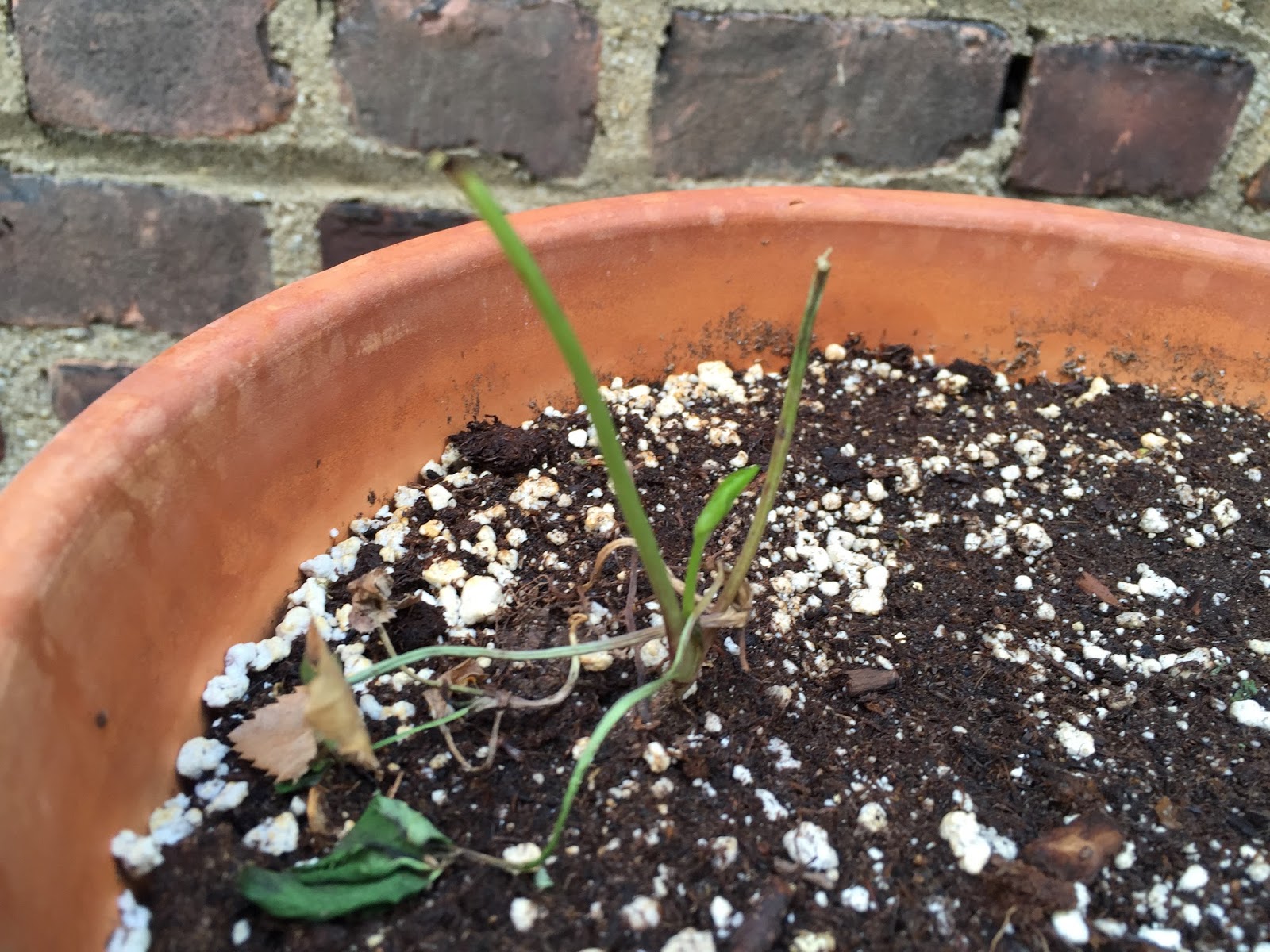
The second is a succulent, of the variety known familiarly as hens-and-chicks (Sempervivum tectorum).  I'm dubious about the prospect of a succulent overwintering outdoors, but I'm giving it a try.  I planted the succulent with the Dwarf Alberta Spruce.


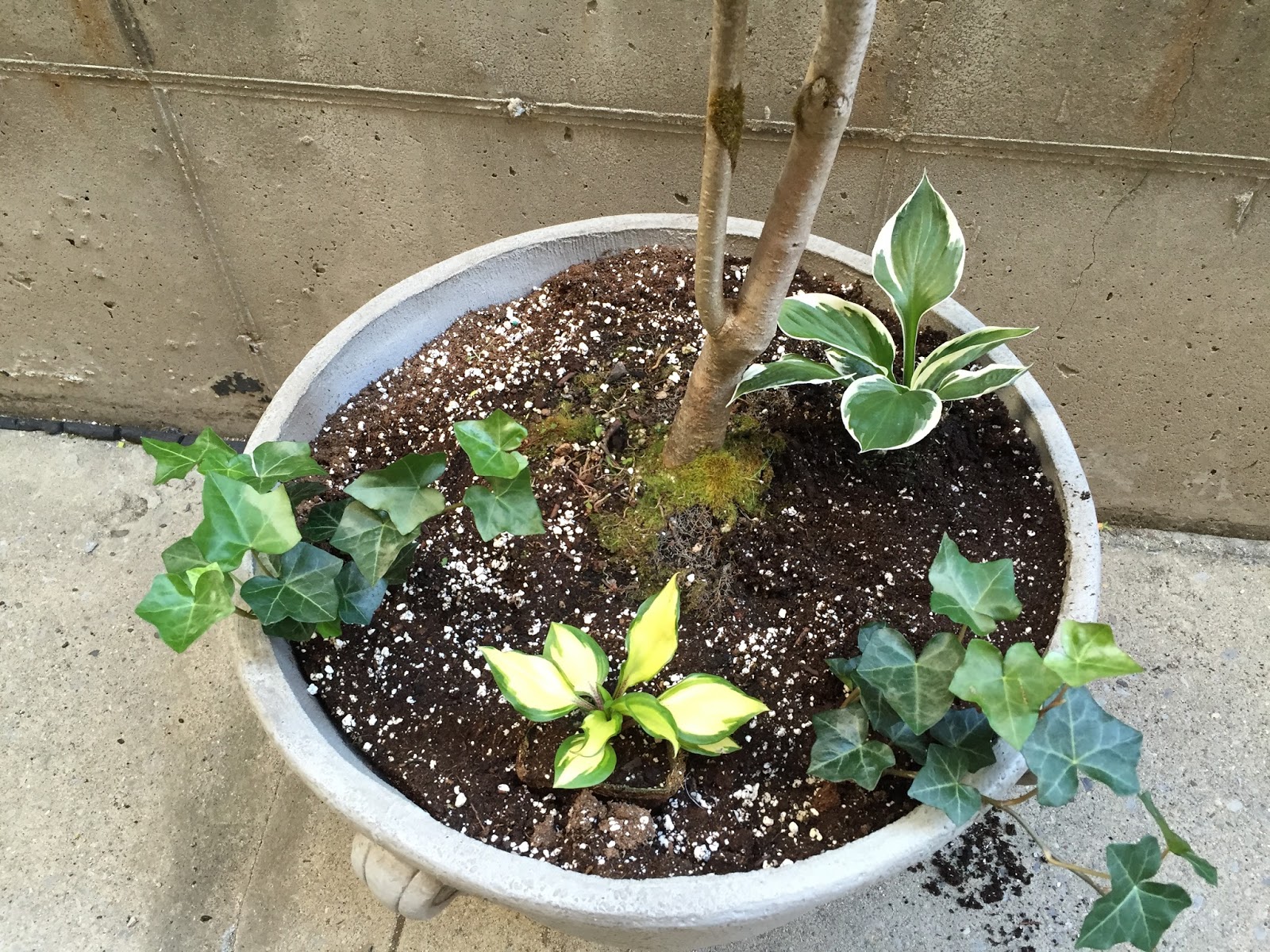
The third is a Victory hosta.  Victory is a giant hosta, which I did not realize until I got it home - it can grow to three feet wide and four feet high.  (I feel a little like I just adopted a St. Bernard puppy without knowing how big it would grow.)  It was named Hosta of the Year for 2015.  I think it eventually will need its own pot, but for now, it's in with the Jim Dandy holly., the English ivy, and the Raspberry Sundae hosta.


Third, I wanted to give you an update on how some of my plants survived the unexpected low temperatures of last week and the week before - basically, two separate cold snaps.  The good news is that everything is still alive, though as you can see from the photo above, the Dwarf Alberta Spruce is still doing whatever the opposite of "perking up" is.

The Bleeding Heart looked just terrible after it got frosted - all of its flowers and leaves were dead.  The hellebore too - dead, dead, dead.  So I took the pot inside to avoid the second cold snap, and both plants immediately put out new growth.  The pot's been back outside since mid-last week.  Here's the Bleeding Heart, with plenty of new growth.


The hellebore has only one new shoot, the little one in between the two dead stalks.


And then there's Dwarf Alberta Spruce, who really needs a nickname.  It would be mean to call it "Dead Al," though.  I told you the buds were opening, and that was true - but because the buds were so dry and brown, the needles inside came out very pale green and dry, and they haven't been gaining any bright green color.  Now, I don't claim to be an expert on botany, but I do know that you need chlorophyll for photosynthesis, and those sparse, pale needles don't seem to have much in the way of chlorophyll. So I'm not wildly optimistic.  Maybe I should just declare the Dwarf Alberta Spruce dead and give its planter to the giant hosta!